Eastern United States Japanese beetle biological control
Silent SpringThe Eastern United States Japanese beetle biological control program sought to restrain an introduced pest by establishing natural enemies rather than relying on broad chemical destruction. The Japanese beetle, initially freed from the restraints it faced in its native range, spread rapidly after entering the United States; yet biological control eventually brought it to minor importance across much of its expanded territory. Its story presents control not as a single decisive attack but as a long effort to recruit specific predators, parasites, and disease into an enduring ecological relationship.
The Beetle’s Decline and the Search for Natural Enemies
During its first dozen years in the United States, the Japanese beetle increased rapidly. By 1945, however, it had become a pest of only minor importance throughout much of the area it had colonized. The account attributes much of this decline to the introduction of parasitic insects from the Far East and the establishment of disease organisms fatal to the beetle. The chronology matters: the restraint emerged through years of biological investigation and establishment, rather than an immediate response to a sudden chemical campaign.
Between 1920 and 1933, researchers searched diligently throughout the beetle’s native range. Some 34 species of predatory or parasitic insects were imported in an effort to establish natural control. Five became well established in the eastern United States. The effort therefore involved both extensive searching and selective success: many species were brought in, but only a portion took hold.
The Tiphia Wasp
Among the established insects, the most effective and widely distributed was Tiphia vernalis, a parasitic wasp from Korea and China. Its control of the beetle proceeds through a precise encounter in the soil. A female Tiphia finds a beetle grub, injects it with paralyzing fluid, and attaches a single egg to the underside of the grub. When the egg hatches, the larva feeds on the paralyzed host and destroys it.
Over about 25 years, colonies of Tiphia were introduced into 14 eastern states through cooperation between state and federal agencies. The wasp became widely established, and entomologists generally credited it with an important role in bringing the beetle under control. The account nevertheless distinguishes its contribution from that of the disease that followed: Tiphia mattered, but an even more important part of the control came from a bacterial enemy.
Milky Disease and Cooperative Treatment
The bacterial disease affects beetles in the scarabaeid family, to which the Japanese beetle belongs, but attacks no other kind of insect. It is also described as harmless to earthworms, warm-blooded animals, and plants. The disease organism’s specificity is central to the case: its lethal effect is directed at a limited group of beetles rather than spread indiscriminately through the surrounding environment.
The disease spores occur in soil. When a foraging beetle grub ingests them, they multiply prodigiously in its blood, turning the grub an abnormal white color. This visible symptom gave the disease its common name, milky disease. It was discovered in New Jersey in 1933 and had become rather widely prevalent in older Japanese beetle infestation areas by 1938.
In 1939, a control program was launched to accelerate the disease’s spread. Because the organism could not be grown in an artificial medium, practitioners developed a substitute preparation from infected grubs: the grubs were ground up, dried, and mixed with chalk. A gram of the standard dust contained 100 million spores. The preparation converted the disease’s natural presence into a means of distribution without changing the account’s central emphasis on a narrowly targeted biological agent.
Between 1939 and 1953, the cooperative federal-state program treated about 94,000 acres in 14 eastern states. Federal lands were treated as well, and private organizations and individuals covered an additional area described as extensive but not quantified. In 1953, production was taken over by a private laboratory, which continued to supply individuals, garden clubs, citizens’ associations, and others interested in beetle control. The effort thus extended beyond government operations into a continuing supply network for local users.
Durability and Contrast with Chemical Eradication
The eastern areas where the program operated came to enjoy a high degree of natural protection from the Japanese beetle. Milky disease remained viable in the soil for years, becoming, in the account’s words, effectively permanently established and increasing in effectiveness. Unlike a treatment whose effects end when spraying stops, this intervention left an enduring biological restraint in place.
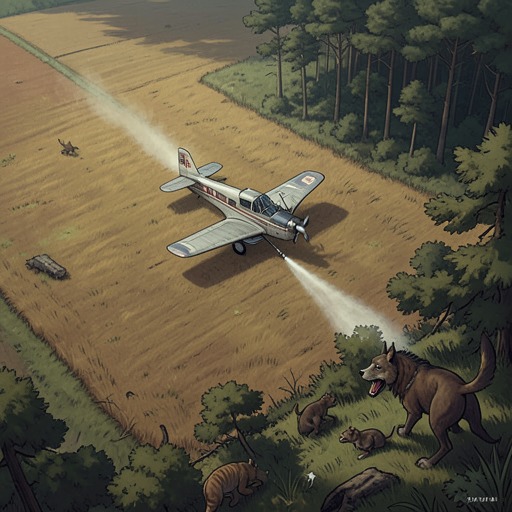
That persistence gives the program its wider significance in the book’s argument. The narrative sets natural controls, with their advantages of permanence and environmental safety, against aerial applications of lethal chemicals over large areas. In the broader discussion, public misgivings about mass spraying grow after destructive campaigns of the late 1950s; the biological-control case offers a different model, one built through patient introduction, host specificity, and cooperation across agencies and communities. The contrast is not that biological control required no intervention: it depended on decades of searching, importing, testing, and distribution. Its distinguishing promise was that the resulting control could become part of the environment rather than repeatedly requiring the environment to be poisoned.